
The training course “Dog in Primary and General Studies” was a first step toward bringing a topic into schools that has often been oversimplified, romanticized, or viewed critically. The aim is to provide children and young people with a well-founded understanding of dogs—particularly working dog sport.
Im Gespräch mit Anna Steinmüller, Lehrerin an einem bayerischen Gymnasium und selbst im Hundesport aktiv, geht es um Erfahrungen aus der Praxis, überraschend große Resonanz aus der Community, bestehende Vorurteile und die Frage, wie Unterrichtsmaterialien so gestaltet werden können, dass sie im Schulalltag tatsächlich ankommen.
K9andSports: The training course has now been completed. What is your personal conclusion after having some time to reflect?
Anna Steinmüller: The approach of bringing this topic into schools is absolutely the right one. Children and young people are growing up in a world where many issues are highly polarized, often without a sufficient factual basis. This is exactly where we should step in and provide knowledge that enables a well-informed opinion on dog sports.
With more than 20 qualified participants who are already able to teach the topic, a strong starting point has been established. However, to achieve a broader impact, a more advanced and forward-thinking approach is needed, which we are now actively pursuing.
K9andSports: Were there any pieces of feedback during or after the event that particularly stayed with you, whether positive or critical?
Anna Steinmüller: The interest among dog sport enthusiasts in sharing knowledge about our sport with children and young people in an educational context is high, significantly higher than expected. Numerous athletes, dog trainers, and members of working dog clubs have reached out to us to get involved and to ask how they can contribute, either as individuals or as training groups.
This shows that we have so far underestimated the potential of our community in this area. At the same time, it becomes clear that the view that an educational approach offers no added value is by no means the majority opinion.
K9andSports: Which topics sparked the most intense discussions during the training, and why do you think these particular issues stood out?
Anna Steinmüller: What was particularly surprising was the area of training dogs as therapy and educational support dogs. Within the available programs offered by dog training schools, there are sometimes significant differences that directly impact the quality of the work and the way knowledge around “dog-related topics” is conveyed.
This also applies to the level of expertise and the assessments of working dog sport, which vary greatly and are often shaped by prejudice depending on the individual case.
K9andSports: You also deliberately addressed topics that rarely come up in the classroom. Where did you notice that teachers still have genuine uncertainties?
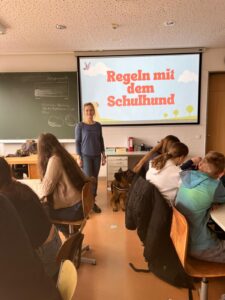
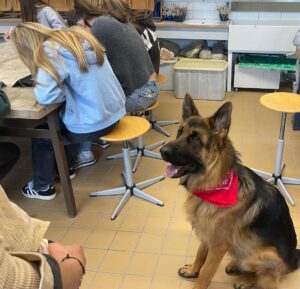
Anna Steinmüller: I work as a teacher at a Bavarian secondary school myself and trained my German Shepherd, Crimm, whom I also handle in dog sports, as a school dog. From the very beginning of my idea, I encountered numerous reservations, both from colleagues and superiors, which were based solely on the breed and often rooted in a lack of knowledge. Not to mention working dog sport. Such perceptions are often passed on unconsciously.
Building a professional standing in such an environment was not always easy. It repeatedly raised the question for me: if such prejudices exist even within a teaching staff, how quickly are opinions formed in the public without well-founded arguments ever being heard?
A special thanks at this point goes to my colleagues Christina and Bettina. Together, we identified where teachers have a concrete need for further training on the topic of working dogs. They have supported the project from the very beginning and continue to stand behind it to this day.
K9andSports: Were there any points where you felt you were reaching limits, either within the school system or among the participants themselves?
Anna Steinmüller: The prejudices that exist in society toward our sport and working dog breeds have a significant impact on projects like this. However, Kerstin Bollig, Patricia Knabl, and I, who are all closely involved in the training and the project “Working Dog in the Classroom,” do not see this as a limitation but rather as a clear motivation. Our goal is to continue growing and to enable children and young people, through well-founded knowledge, to form their own informed and nuanced opinions.
It is well known that bureaucratic hurdles within the school system are significant. We also clearly experienced this in the process of registering the training course as an official event.
K9andSports: Has anything concrete already emerged from the training, such as new contacts, project ideas, or initial implementations?
Anna Steinmüller: Yes, Kerstin and I have currently brought together a number of dog sport enthusiasts and K9andSports ambassadors to rethink the project and expand its reach.
K9andSports: Where do you currently see the biggest obstacle to ensuring that such content truly makes its way into the classroom?
Anna Steinmüller: The biggest obstacle is the bureaucracy that teachers are confronted with in their daily school life. In public perception, there is often the image that pedagogical work ends at midday and leaves plenty of free time. In reality, however, the workload of teaching, educational responsibilities, organization, and administrative tasks is significantly higher.
All the more important is the development of a concept that also reaches and motivates teachers with no connection to dog sports to engage with the topic, and to do so with as little organizational effort as possible. Not every school and not every teacher has the capacity to implement practical components or allocate additional teaching time.
K9andSports: What would need to happen for such initiatives not to depend solely on individual committed teachers, but to become more widely embedded within the system?
Anna Steinmüller: This is exactly where we want and need to start by providing a broad target group with teaching concepts that are easily accessible while remaining practical and applicable. Our working group focuses on offering teaching materials that are straightforward, academically sound, and engaging and application-oriented for students.
At the same time, we deliberately do not limit ourselves to primary education but also develop concepts for older students, up to upper secondary level. In an educational context, the topic of dogs is often romanticized and oversimplified, as if it were only relevant for younger children. We want to broaden and differentiate this perspective.
K9andSports: What are the next concrete steps? Will this lead to new formats or further opportunities?
Anna Steinmüller: As mentioned, the goal is to develop concrete concepts and materials that provide a low-threshold offering for teachers across all school types and grade levels. At the same time, we are aware that teachers for whom this topic has not previously played a role cannot be expected to work through it extensively in addition to their existing workload.
Many colleagues are already doing excellent work and continuously developing their teaching. However, independently exploring an entire subject area and preparing it didactically is far more demanding than is often assumed.
This is exactly why materials are needed that can be used immediately, are professionally prepared, and already integrate key content. Only in this way can they be meaningfully incorporated into everyday school life without creating additional workload.
K9andSports: If you look back in a few months, how would you recognize that the training has truly made a difference?
Anna Steinmüller: When K9andSports was founded, I immediately asked myself as a dog sport practitioner: how can I contribute? After all, the image problem affects all of us. This is exactly the question we want to answer by providing concrete guidance for dog sport enthusiasts who are interested in educational work.
We want to equip them with knowledge and concepts that they can apply locally, whether in schools or clubs, when working with children and young people. In the long term, effective education can only succeed on multiple levels.
 English
  German